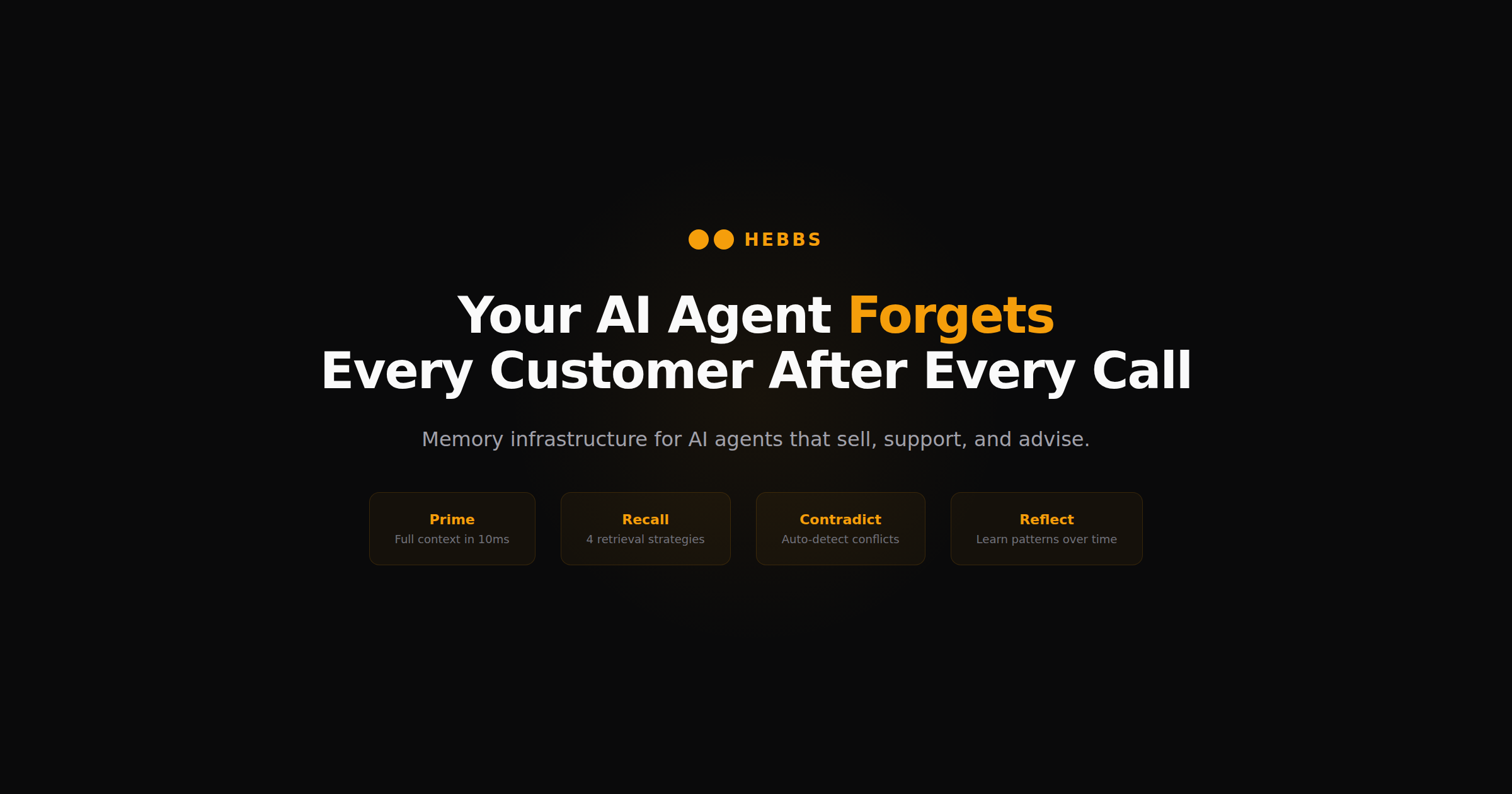
Your AI Agent Forgets Every Customer After Every Call
CRMs store records. They don't store understanding. HEBBS gives your AI agents a cognitive memory that remembers every interaction, preps before every call, catches contradictions, and learns patterns your team would miss.
Your sales rep just finished a call with Acme Corp. The prospect mentioned their budget got cut from $100K to $50K. The rep typed a note into Salesforce. Two weeks later, a different rep pulls up Acme Corp before their follow-up call. They see the note. They do not see that three previous calls showed a pattern: every time legal gets involved, the budget drops. They do not see that Acme Corp’s procurement process is structurally identical to Initech’s, where closing took 6 months. They do not see that the SOC2 question Acme keeps asking was answered in a blog post your marketing team published last quarter.
They see a CRM record. They do not see understanding.
CRMs Are Record Systems, Not Memory Systems
A CRM stores structured data: contact name, deal stage, last activity date. It is a database with a UI. It answers “what is the current state of this deal?” It does not answer:
- “What happened with this account, in order, across all touchpoints?”
- “What led to the budget reduction?”
- “Which other deals followed this same pattern?”
- “Does anything the prospect said last week contradict what they said this week?”
These are memory questions. A CRM cannot answer them because a CRM does not remember. It stores. Storing and remembering are different operations. Storing puts data in a table. Remembering means retrieval is shaped by context, recency, importance, and the relationships between pieces of information.
What a Memory-First Agent Looks Like
Here is what changes when your AI sales agent has cognitive memory instead of a CRM lookup.
Before a call, the agent runs prime:
hebbs prime --entity-id acme-corpThis returns a fused context that crosses two boundaries no CRM crosses:
-
Entity memory (temporal): every interaction with Acme Corp, in chronological order. Call notes, emails, Slack threads, meeting summaries. Not just the last activity, but the full narrative.
-
Shared knowledge (similarity): product docs, case studies, competitive intel, blog posts, and training materials that are relevant to what Acme Corp is dealing with right now.
The agent walks into the call knowing the full history AND the organizational knowledge that applies to this specific deal. No human could synthesize this in 30 seconds. The agent does it in 10 milliseconds.
During the call, the agent captures what matters:
hebbs remember "Budget revised down to $50K, CFO pushed back" \
  --entity-id acme-corp --importance 0.8
Or the rep drops a call summary into entities/acme-corp/call-2026-03-22.md and the system indexes it automatically. No fields to fill. No picklists. No mandatory data entry. Just write what happened.
After the call, three things happen without anyone asking:
-
Contradiction detection: HEBBS notices that “budget $100K” from last week and “budget $50K” from today are contradictory. It flags this automatically. No rule engine. No workflow. The memory system understands that these two facts cannot both be current.
-
Pattern recognition: After enough deals,
reflectconsolidates memories into insights. “Deals where legal gets involved before technical evaluation take 2x longer to close.” “Prospects who ask about SOC2 in the first call close at 3x the rate of those who ask in the third call.” These insights emerge from the data. No analyst built a report. No dashboard was configured. -
Cross-entity learning: The agent notices that Acme Corp’s procurement process is structurally similar to Initech’s, where you closed 6 months ago. Analogical recall surfaces the Initech playbook that worked, without anyone tagging it or creating a “similar deals” field.
The Folder Convention
HEBBS uses a file-first architecture. Your workspace looks like this:
workspace/
├── entities/
│   ├── acme-corp/
│   │   ├── call-2026-03-15.md
│   │   ├── call-2026-03-22.md
│   │   └── emails/sarah-thread.md
│   ├── initech/
│   │   └── discovery-notes.md
│   └── globex-corp/
│       └── inbound-lead.md
├── products/
│   └── features.md
├── case-studies/
│   └── initech-migration.md
├── competitive-intel/
│   └── vendor-x-comparison.md
└── training/
    └── objection-handling.md
Everything under entities/ is automatically scoped to that entity. Everything outside is shared knowledge. No configuration. No tagging. Drop files in the right folder and the system understands the structure.
A case study about Initech that lives in case-studies/ is shared knowledge. But add entity_id: initech to its frontmatter, and it also appears when you prime for Initech specifically.
Four Questions, Four Strategies
The same memory answers different questions depending on how you ask.
Similarity: “What do we know about SOC2 compliance?” Finds every memory, across every entity, that is semantically related to SOC2. Product docs, case studies, call notes where prospects asked about it.
Temporal: “What happened with Acme Corp this quarter?” Reconstructs the chronological narrative. Every call, email, and note in order. The agent sees the story, not a snapshot.
Causal: “What led to the budget cut?” Traces the chain of events. Legal involvement, CFO review, competitive pressure. Cause and effect, not just correlation.
Analogical: “Which deals looked like this one?” Finds deals with structurally similar patterns, even if the industries, company sizes, and products were different. Pattern matching across entities.
How Teams Deploy This
HEBBS runs on your infrastructure. One line to deploy the server:
curl -sSf https://hebbs.ai/server | OPENAI_API_KEY=sk-... shEach team member installs the CLI:
curl -sSf https://hebbs.ai/install | sh
hebbs login --endpoint https://hebbs.company.com:8080 --api-key hb_live_sk_...
Files can come in three ways:
- Manually: reps drop notes into
entities/{account}/folders - CLI:
hebbs push ./call-notesuploads a batch - GitHub Action: push to a repo, files sync to HEBBS automatically
Your AI agent (Claude Code, OpenClaw, or any agent with the HEBBS skill installed) automatically gets memory. No SDK integration. No glue code. Install the skill, and the agent knows how to remember, recall, and learn.
What HEBBS Is Not
HEBBS is not a CRM replacement. It does not manage pipelines, forecast revenue, or generate reports. It does not have a deals board or a contact database.
HEBBS is the memory layer underneath. It is infrastructure, like a database is infrastructure. Your CRM, your agent, your support system, your legal research tool: they all can use HEBBS as their memory backend. Each gets a workspace. Each workspace is isolated. Data in one workspace never leaks into another.
Your CRM tells you what stage a deal is in. HEBBS tells your agent what actually happened, why it matters, and what to do about it.
Try It
Deploy the server, push your call notes into entities/, and run a recall. The first time your agent walks into a call knowing the full history of the account plus the organizational knowledge that applies, you will understand why memory is not a feature. It is the foundation.
Get started in one line.